The blade will also get caked with cement dust which makes it cut a lot less effectively and doesn't really take all that long to get like that.
So my final word on reciprocating saw blades for stucco is to only use them as much as you have to, where a circular type blade would not work as well which is usually detailed type cutting applications.
A Hole Saw Will Also Work On Stucco...
A hole saw blade will cut only one type of hole in the wall and as you can tell from the picture on the right these are circular holes.
These are probably one of the easier types of tools to use and are simply attached to a drill and the diamond grit on the hole saw a bit eats through the stucco quite well. They make these in just about any size you need.
These can come in so many different sizes which is helpful for many different things such as plumbing fixtures coming through the wall, dryer vents, exhaust vents and so on.
If you have a round hole that needs to be cut in your stucco exterior then these hole saw bits are the only way to go and make the job a lot easier and a lot more efficient.
How About An Oscillating Multi Tool?
Oscillating multi tools can also be helpful for cutting holes in wall, equipped with the correct blade, that is. These usually use a carbide blade that will do a decent job at cutting through stucco.
This is also a tool for more of the detailed type cuts and typically don't last that long but from my experience they do last longer than jigsaw or reciprocating saw blades do. I know a lot of electricians that like using these tools for cutting out electrical boxes.
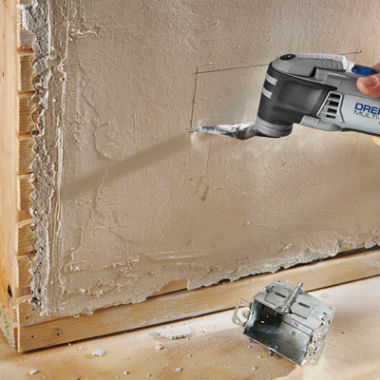
dremel.com
If you do plan on using in oscillating tool with a carbide blade, then I would recommend getting a few just in case they wear out quickly.
A quality carbide blade should last a little while and keep in mind that the better quality blades usually cost more, in general.
Below, are two different diamond blades that you will typically find for a multitool, the carbide blade looks a little different and has teeth on it (not pictured).
Will A Mini Saw Work On Stucco?
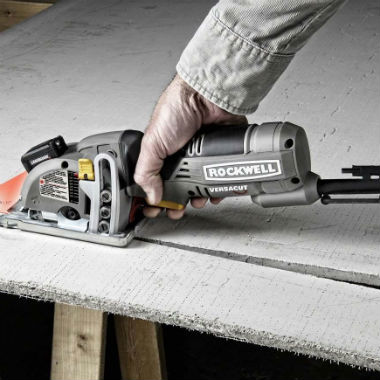
These mini circular saws actually work pretty well on stucco and have the equivalent power that an angle grinder would.
The advantage to using a mini circular saw is the fact that you have a depth guide to use and the position of the trigger is a little bit more comfortable on the hand.
You will need a diamond blade to go with these though, which is not that big of a deal considering you would need a diamond blade for a standard circular saw or an angle grinder anyways.
dremel.com
Most of these mini circular saws will use a 4.5" blade, which is the same size as some angle grinders, so a pretty standard blade so to speak and easy to find online.
Are Diamond Blades The Only Thing That Will Cut Through Stucco? - Diamond Blades are typically the most common types of blades used for cutting through stucco but you can also use carbide blades.
It is important to understand that a diamond blade is going to work 100 times better than the carbide blade and have 10 to 20 times the life as well. When in doubt, always look for a diamond blade over a carbide blade.
How Long Will A Blade Last? - This depends again, on the type of blade you actually end up using. I have cut several hundred linear feet using a diamond blade (wheel).
A carbide blade is going to be more commonly found on an oscillating multitool and a reciprocating saw and has a tendency to only last a few feet, in my experience anyways.
There are many more determining factors that go into how long a blade will actually last in these things are related to the amount of force you use, the amount of heat that builds up while cutting, the quality of the blade and materials that it is made of (price of the blade) and other variables like that.
The best advice I would have is to go with a diamond blade, if possible and get a moderately priced one and stay away from the cheaper ones.
What Is The Best Way To Cut Through Stucco? - If you are simply cutting through stucco to remove it from the wall then a circular type blade (diamond) is by far the best tool you can use, hands-down.
If you are looking to cut finer detail type things then you may want to use an oscillating tool, a reciprocating saw or a jigsaw (in that order) to get a more precise cut.
How Much Dust Does Cutting Stucco Make? - If you are using a circular diamond blade type of cutting tool it is going to create a ton of dust, which is come parable to the amount of smoke a small fire pit would make.
That is quite a bit of dust! You really want to take extra precautionary measures to make sure you have adequate ventilation and have the proper tools to combat the best especially if you are sensitive to airborne particles.
Using a reciprocating saw, oscillating multitool or a jigsaw will create far less dust in the cutting process than a circular saw or angle grinder would.
It is significantly less but is still present and the same precautionary measures should be taken.