Think of single-ply as using just an umbrella, which is great for big drops of rain, but wind-blown mist still gets through, while two-ply is like pairing the umbrella with a light poncho underneath, so anything that slips past the first layer gets caught and shed by the second.
In a traditional three coat (or one coat) stucco wall, the “paper” (your water-resistive barrier, or WRB) sits behind the metal lath and exists for one big reason... to move water down and out before it ever reaches the wood. Using two layers instead of one gives you forgiveness during installation and long-term protection once the house is buttoned up.
What Is Two-Ply Stucco Paper?
Two-ply paper is simply two separate sheets of asphalt-infused building paper that are lightly tacked together at intervals from the factory. Those light bonds keep the sheets married while you roll, cut, and hang, so it behaves like one product during install, but each sheet still acts as an independent layer once it’s fastened to the wall.
What “Two Plies” Means (and how it’s different from single-ply)
- Outer sheet: sheds most water and takes the brunt of fastener penetrations.
- Inner sheet: provides a second defense and a thin slip/drain space, so water can travel downward instead of inward.
Most two-ply setups use asphalt-saturated building papers (often called Grade D) or other approved WRBs intended for stucco. The big idea isn’t the brand itself, it’s having two independent layers that overlap correctly and create a more reliable drainage path.
What About Single-Ply Paper?
Single-ply paper exists, but in stucco work it’s mostly used as a floor/ground covering or slip sheet during plastering and not as the wall’s water-resistive barrier. Could you use two layers of single-ply on a wall? Technically yes, but it’s inefficient:
- You’re rolling and lapping twice as many sheets
- You’re driving twice the fasteners (more penetrations, more labor)
- Corners and details take longer, with no real benefit over a standard two-ply WRB setup
In practice, it’s more economical and cleaner to install a proper two-ply stucco paper (two independent layers of WRB designed for walls). It conforms better, laps predictably, and gives you the redundancy and drainage path you want, without doubling your time and staple count.
Paper Weights: 10-Minute vs 60-Minute (What the “minutes” actually mean)
“Minutes” = water holdout rating, not time on the wall. It’s a lab test that indicates how long the paper resists liquid water under specific conditions. It doesn’t mean the paper is waterproof for that many minutes in real life.
- 10-Minute Paper (lighter, more breathable): Thinner sheet with higher permeability, so it dries faster and helps the wall balance moisture. It’s common in two-ply stucco assemblies because it layers easily, conforms to corners, and plays well with drainage. Tears and wrinkles show up quicker than with heavier paper.
- 60-Minute Paper (heavier, more robust): Thicker sheet with more asphalt saturation, so it has greater water resistance and toughness during handling. It’s less permeable (breathes less) than 10-minute paper, which can be useful in high-exposure locations, but it’s stiffer and can be harder to lay flat if the substrate is uneven.
Shingle-Style Laps (top over bottom)
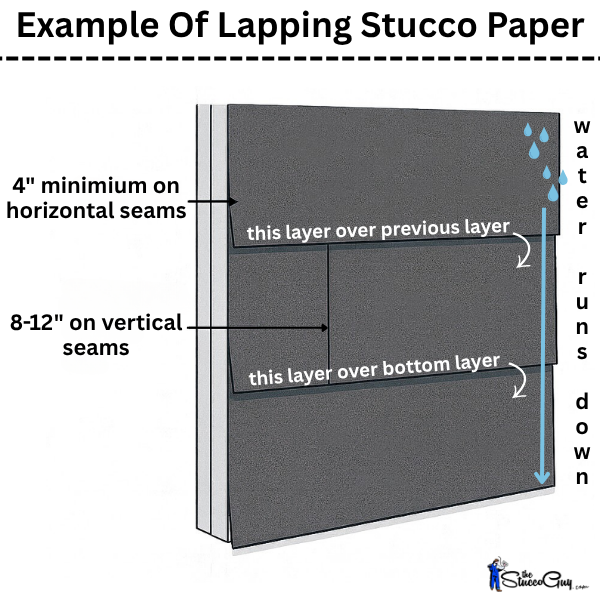
Lay each course like roofing shingles, so water always steps over the layer below, never behind it. A simple rule of thumb works well on most jobs:
- Horizontal laps: 4 inches (minimum)
- Vertical laps: about 8-12 inches
Everything should layer so that the top pieces of paper overlap the bottom pieces of paper, so gravity helps you, not fights you. This is done by installing the paper from the bottom of the wall first and working your way up, overlapping the joints as you go.
Integrating into window flashings is a little trickier. The paper needs to go under the bottom (sill) flashing of the window and then be counterflashed over that, so any water that gets behind the stucco lands on the flashing and drains out instead of into the wall.
The Drainage-Path Mindset...
Water wants to go down, not into the wall itself, when functioning properly. Build every detail to help that happen:
- Stucco slows and sheds most rain.
- Outer paper catches what gets through and shunts it down.
- Inner paper backs it up and forms the drainage plane.
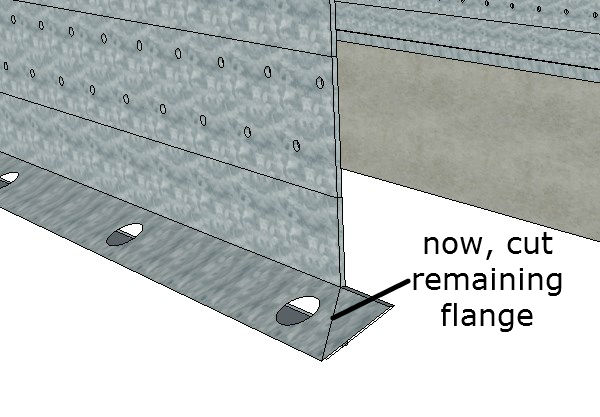
- Weep screed at the base is the exit. Keep it clear at all times and don’t bury it, block it, or caulk its slots.
When the two layers are lapped correctly and the weep screed is open, incidental moisture has a low-resistance path back to the outside.
Two-Ply “Drainage” vs a Dedicated Drainage Mat (Rainscreen)
Two-ply paper creates only a very thin slip/drain pathway between the sheets and helps water slide down the wall (movement), but it isn’t a true air space.
A dedicated drainage mat (rainscreen) adds a real capillary break and ventilation gap behind the stucco. That bigger gap:
- Moves more water faster and more predictably.
- Reduces the effect of wicking into the sheathing.
- Improves drying (air can actually circulate), which is a plus in wet or coastal climates, on tall/windy walls, or behind darker finishes that run hotter.
Two-ply paper is the baseline that most 3-coat walls use and it works when detailed correctly. A rainscreen is the upgraded path that results in more materials and labor, but much better drainage and drying. Consider it for high-exposure walls, complicated elevations, or anywhere you want extra moisture margin.
“Aren’t We Poking Holes in the Paper?”
Fasteners for lath (stucco wire) have to go through the paper in order to attach the wire to the wall. That’s normal in a both a 3 coat and 1 coat stucco system. Here’s why it still works:
- Asphalt-infused paper self-seals. The asphalt in the sheet helps the paper snug up around staples/nails, minimizing the opening at each penetration.
- Two layers = built-in backup. If the outer ply takes the hit, the inner ply remains a continuous drainage surface.
- Shingle laps + weep screed = exit path. Overlaps are arranged, so water always steps down and out through the weep screed at the base.
- Smarter hardware helps. Corrosion-resistant fasteners are used because they take on quite a bit of water. These can be sealed for extra protection using a caulking, if needed or wanted.
We’re not trying to make a boat here, we’re creating a reliable drainage plane that tolerates penetrations and still moves water safely down the wall to eventually drain.
FAQs:
Can I use house wrap instead of two plies of paper?
For 3-coat stucco over wood sheathing, the typical approach is two independent layers of stucco-rated WRB. Some regions allow alternatives with equal or better performance.
How do I know if my paper was installed right?
Look for shingle-style overlaps, clean integration with window/door flashing, dark-colored paper (not sun faded), minimal wrinkles, and an open weep screed at the base.
Is this required everywhere?
Many jurisdictions expect two layers behind stucco over wood sheathing. Always check your local code and the project specifications.