Identifying Various Cracks In Stucco

There is a saying out there that goes…. “There are two types of stucco houses, one that is cracked and ones that are going to”. Cracking is inevitable when it comes to stucco, just like any type of cement based product. Expansion, wind and stress all play vital roles in why cracking occurs. 

It is normal for plaster to crack from movement and stress, especially in a new home that has not had the time to settle into it's final resting position. The wood dries, expansion and contraction occurs, the vibrations from the construction equipment around the area and other factors play a significant role in this, especially for a brand-new home.

Other issues that cause cracking issues in plaster can be brought on by improper installation of lath, improper mixing procedures and a couple of other variables.

There are certain patterns that will allow you to identify what actually caused the wall to crack. Let's take a look at some of the different types of crack to get a better understanding of why they occur.

Hairline Cracks:

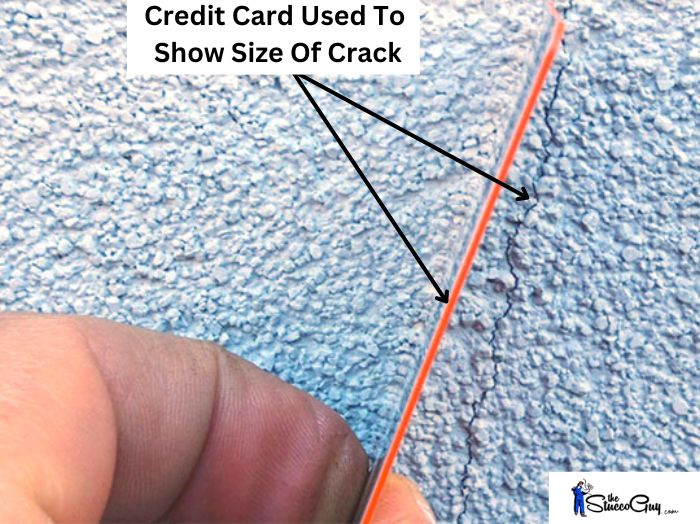
Hairline cracks are typically around a 1/16 of an inch wide or smaller, if the crack is bigger than that, then chances are that some other element is the culprit. Below are some examples of some hairline cracks that have occurred.

Credit Card Used To Show Size Of Crack

How To Repair These: These types of cracks can usually be repaired using a caulking of some sort and are fairly easy for the do-it-yourselfer. Just squeeze some caulking in the cracks and wipe off the excess and you should be good to go. I have a more in depth tutorial on repairing hairline cracks if you are interested in knowing more.

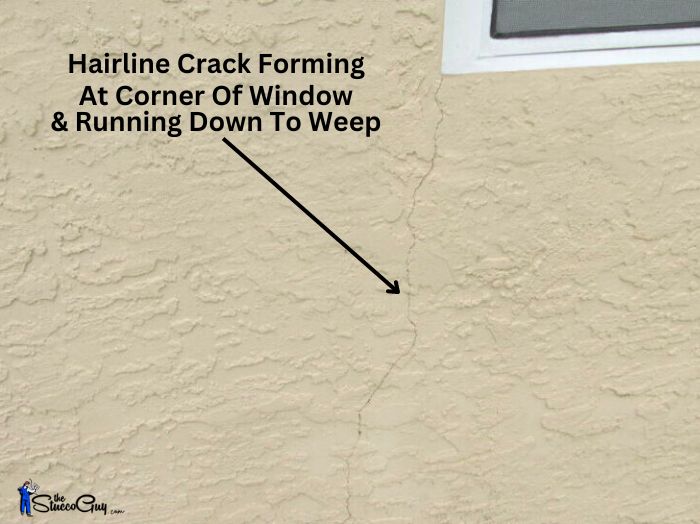
A lot of times, these types of hairline cracks form at the corners of windows and doors, which makes sense because when you open and close the window or door, it creates a lot of movement and a lot of the time this is why these cracks form right at the corners.

They usually can travel quite a way until they hit a stopping point like weep screed or an expansion joint of some sort.
Hairline Crack Forming At Corner Of Window
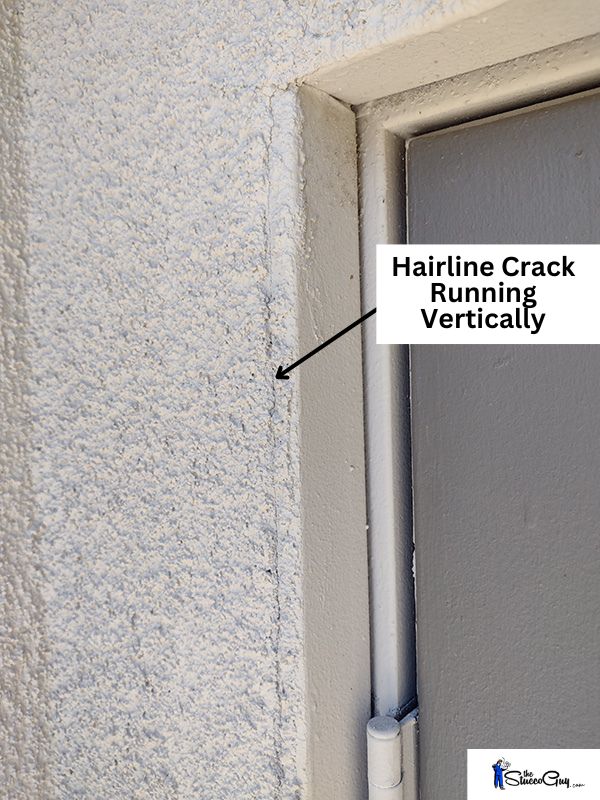
Hairline Crack Running Vertically
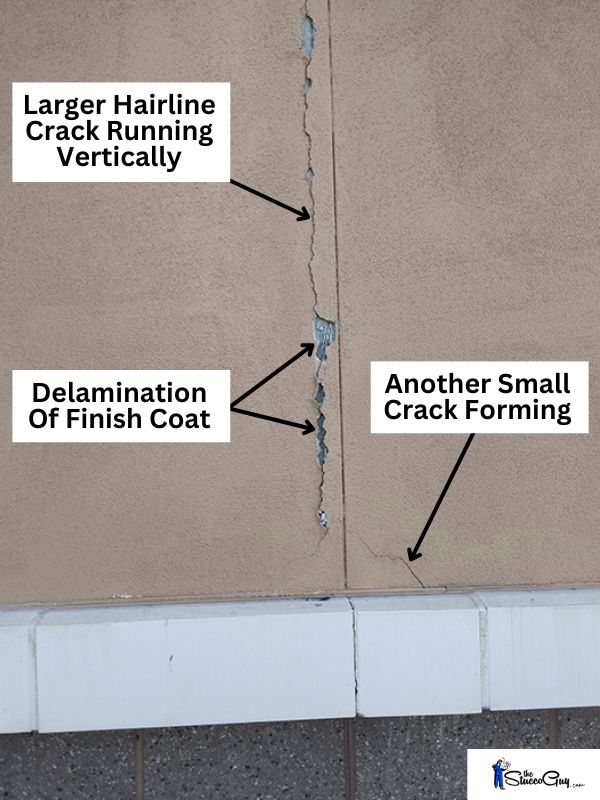
Larger Hairline Crack Running Vertically

Larger Hairline Cracking With Delamination Issues

Cracks & Holes In Foam Trim Too?

I see a lot of cracks on the foam trim that is used on stucco houses quite often and most of the time it is where two pieces of trim meet. The cause is usually because fiberglass mesh tape was not used on the seam where the two pieces met.

If installed like this, it will likely crack over time due to expansion and contraction that is brought on by the fluctuation in daily temperatures.

How These Are Typically Installed: You would typically hang the foam trim and then apply a piece of mesh tape over the seam, apply a thin layer of polymer modified cement to the area and then apply a finish coat over the top of that.

An Example of How To Fix 2 Foam Issues: Sometimes, there will be a chunk missing out of the trim because they are essentially made out of EPS foam on the inside, which is very delicate. The image below shows a good example of this where the larger area would have to be filled with foam or caulking and then the crack would have to be caulked or mesh taped and then a finish coat (or two) applied over that.

A lot of times if you have foam trim around your garage doors, these will usually get hit or damaged in some way and is a very common repair we typically see due to the soft nature of this material.

What About Spider Cracking?

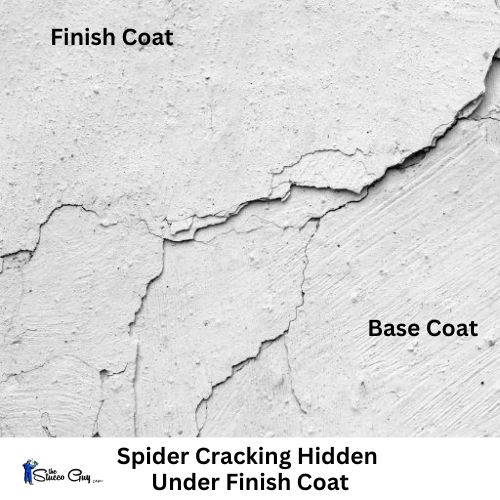
This type of cracking is basically a sign that the base coat did not cure properly or has been compromised in some way. This can be caused by many different things including: the base coat(s) drying too quickly, too much water in the mix, the material was mixed incorrectly or the material was applied when the temperature was too cold or too hot outside.

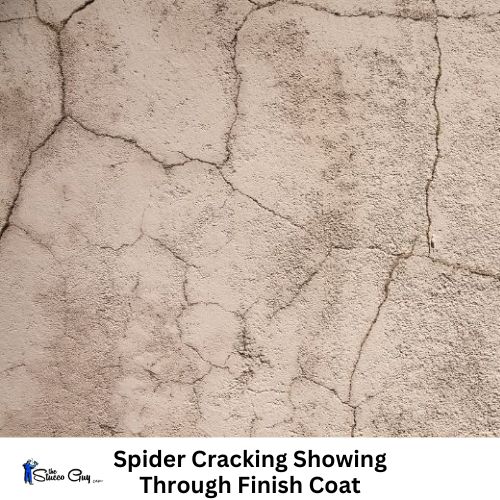
Water can also weaken the base coat after years of intrusion and make it soft and more likely to crack like this and can even show through the finish coat, especially if it is a cement based finish.
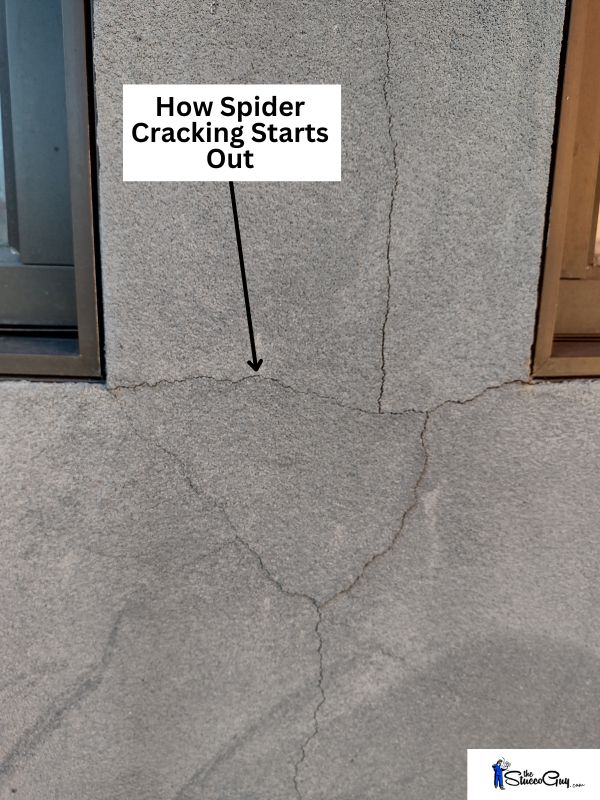
Less Severe Spider Cracking Starting To Occur
Spider Cracking Showing Through Finish Coat
Spider Cracking Hidden Under Finish Coat

Important Note: You will want to cautiously repair spider crack issues on your stucco walls. What I mean by that is that you will need to make sure that there is no damage underneath the base coats, which can be hard to do without removing some stucco in select areas.

Most of the time, spider cracking is not really an issue underneath of the stucco itself, it was some sort of issue with the base coat. If water has been getting in for a long time, damage to the paper underneath could be a real possibility.

How To Fix These: The remedy to fix these types of cracks would usually be to mesh over the entire area and apply a skim coat, or you can even try to get away with applying a finish coat on top of the mesh, in order to eliminate these cracks from reappearing over the newly finished surface. 

* This is okay to do as long as you know that the water resistive barrier underneath is fine and undamaged.

More Severe Cracking Issues:

There are cases where there are more severe cracking issues that can happen and I would classify these, personally, as being three-sixteenths of an inch or larger and the larger they are, the more serious the issue likely is.

These larger cracks are usually a result of something moving or shifting on the structure itself, making large cracks appear.

I have even seen these larger cracks appear between two dissimilar materials and will still form larger cracks due to the different expansion and contraction rates of the two materials, which really boils down to movement.
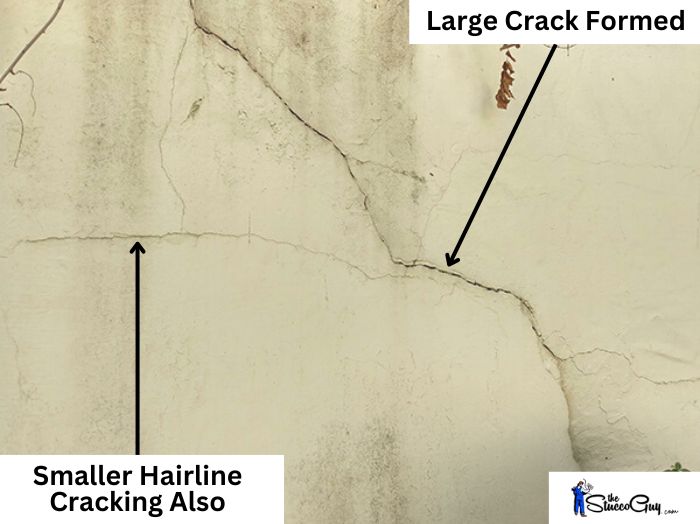
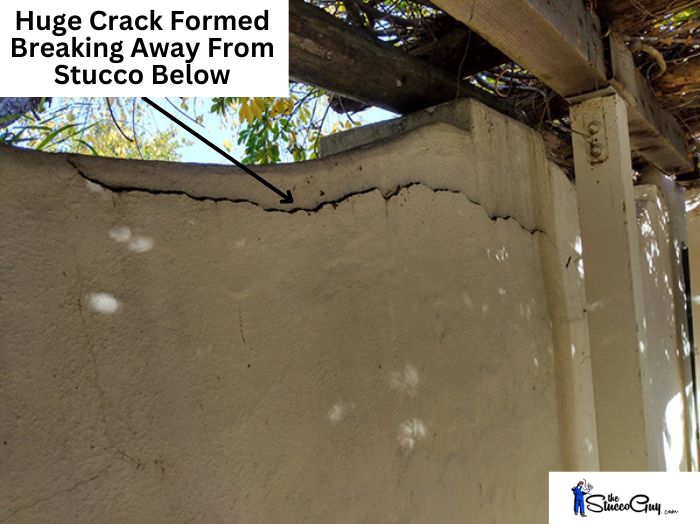
Large Crack Formed With Smaller Cracks Expanding Too
Huge Crack Formed With Significant Upper Wall Movement

I would really recommend two different routes for repairing these types of cracks and the size of the crack, in terms of width, is going to be a major factor and how I would tackle the repair.

Smaller Cracks: Do some investigating to see if you can find any shifting or movement anywhere first before repairing the areas. This will eliminate the cracks from reappearing in the future.

For cracks that are smaller, I would grind the crack out, blow out the excess dust, apply a polyurethane caulking and then when the material was dry, apply texture to the remaining area of the crack using an acrylic product of some sort.

Larger Cracks: If the cracks are half an inch or larger (very severe), then I would really recommend that you remove a little stucco and take a look at the footings, framing and roof of your structure around that area to see if you notice anything. You would essentially be trying to find some type of clue to a larger issue that may be taking place. You would then have to patch the stucco area or areas where you removed material.

Patterns In The Wall:

Patterns may appear on rare occasions and can be a sign of what is causing the problem. These cracks will usually be straighter than normal and will usually have 90 degree patterns to them, either vertically or horizontally.

Sheathing Issues: For example, I have seen vertical cracks appear on a wall that were very straight and followed a definitive path and were spaced out every four feet. The problem was that the OSB that was underneath the stucco got wet somehow and expanded and formed vertical cracks every four feet, which is the width of a full sheet of this material!

Inadequate Overlapping Of Wire In Lath: When there are defining vertical and/or horizontal cracking occurring throughout the wall that appear in longer, straight runs, then more than likely it is caused by the lath. 

Either the lath (the wire specifically) was not nailed or stapled off properly or the overlap was not adequate where two pieces of the lath met, which can be a more serious kind of cracking to remedy, as far as fixing it goes due to the time aspect that is involved.

Because the wire is essentially loose in some spots or not overlapped enough, then it will actually have a higher potential for forming even more cracks as time goes on.

Dissimilar Materials: Cracks will also often form where two dissimilar materials meet and cause a fairly straight line cracking issue where these two materials meet up.

One example of this is when no weep screed was used in a wall and the crack formed where the bottom plate of the wall and the concrete foundation meet, causing a fairly straight horizontal crack to appear. 

The area between where a wooden framed wall and concrete or cinder block wall meet is also a common area where these types of cracks will form and will cause either a vertical or horizontal crack to appear, depending on how the two materials are joined.

Options For Fixing These: To correct the problem the correct way, the stucco has to be broken out and the lath has to be modified somehow. This can include things like: the lath having to be nailed off, more wire added to joint lines or replaced, or it has to be modified altogether, adding a transition piece of metal like a control joint, weep screed, plaster stop, etc.

You could try applying caulking to these cracks, if they are hairline cracks.

Diagonal Type Cracking:

Sometimes you will see a diagonal type pattern that will signify some other type of issue. Theses are usually in the general categories of seismic movements, house settling or shifting, etc.

The ones that tend to develop around a door or window are the cause the framing in the door or window or due to vibrations in that particular area, which I already touched on.

Some are more serious than others, usually a good rule of thumb is the size and depth of the crack. If it is more than 3/16 of an inch wide, then it should be a bit higher on your priority list than smaller ones and you should investigate the cause.
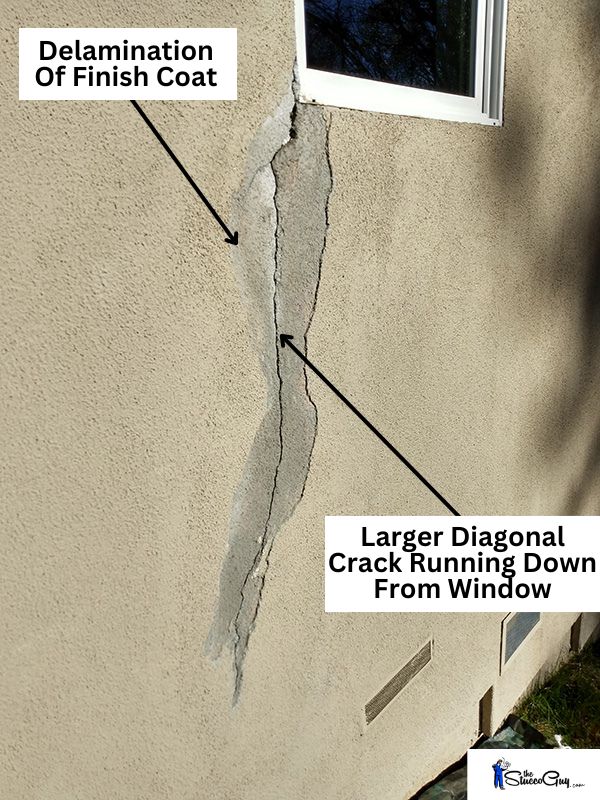
Larger Diagonal Crack Running Down From Window

A Foundation Settlement Crack

About Me Image
About the Author

The Stucco Guy

Ryan Retired Stucco Contractor

I’m Ryan, a longtime stucco contractor who has spent plenty of years getting dusty, chasing cracks, matching finishes, and figuring out what actually works in the real world. I created TheStuccoGuy.com to make stucco a little less confusing, help homeowners avoid expensive mistakes, and give you practical answers without all the fluff.

Take a look around, and if something still has you scratching your head, send me a question. I’m always happy to help.

Leave a Comment:

38 comments
Emily says

You said hairline cracks are normal. My stucco is about a month old on a new addition and I wasn’t concerned when there were some hairline cracks. I am starting to worry however at the number of hairline cracks that have appeared. Is there a point I need to worry when it comes to hairline cracks?

Reply
    The Stucco Guy says

    Hi Emily! It’s true that hairline cracks are normal in stucco, especially as it cures, but the number and pattern of cracks can sometimes indicate an issue. Without seeing it in person, it’s hard to say for sure. If the cracks seem excessive or clustered, it might be worth having a professional inspect them to ensure there aren’t underlying problems. Let me know if you have more questions!

    Reply
Kayla says

I am doing an addition on my house and the contractor just did the base of the stucco, it rained a lot that day he did it. Also, the next day there were lots of small hair line cracks visible. Is it a problem it rained that day he did it and should we be worried about the cracks or is that normal?

Reply
    The Stucco Guy says

    Hi Kayla,

    Rain during stucco application can sometimes affect the curing process, but hairline cracks are not uncommon and could just be from normal shrinkage as it dries. Without being on-site, it’s hard to troubleshoot the exact cause. If the cracks are widespread or deep, it’s worth discussing with your contractor to ensure there aren’t underlying issues. Let me know if you have more questions!

    Reply
Frank says

Hi,
The Brown coat was applied three weeks ago, when we wet the surface, we see the spider cracks.

What do you recommend to do before the 3rd finish coat is applied to fix/resolve the spider crack issue?

We would appreciate a response.

Thank you!

Reply
    The Stucco Guy says

    They sound like hairline cracks, is that correct? If so, that is normal and a part of the stucco process, not to worry. A mesh and skim coat over the cracks would help prior to the finish coat being applied.

    Reply
Lisa says

Hi,
Have received a quote of$2600 to repair 58 linear feet across the back of house where old patio was removed. The weep screed band is rusted out so they are going to replace and go up 1 foot with paper, mesh wire and apply matching 80/20 stucco. Is $44 per sq. ft. what we should expect?
Thank you!

Reply
    The Stucco Guy says

    Repair work often tends to be a little higher and is really “circumstantial” and there is no real “ball park figure” to go off of, unfortunately.

    Reply
Mary Ann kilgore says

Just bought a resale that had stucco removed and replaced and it was disclosed. Looked fine at inspection. 2-3 months later there are horizontal cracks. Should we repair each crack and wait and see or tear off and start over again? How will we know whether this will just keep happening. Other houses in area don’t have cracks.

Reply
    The Stucco Guy says

    Hi Mary,

    I would repair the cracks first and give it more time to see if you do have to tear off the stucco and redo it. It will save you money and would be what I would do if it were my house. Hope that helps.

    Reply
Lillian Bloom says

Hi Ryan, Your descriptions of how to address each type of stucco crack are very clear.
You’ve explained everything step by step. Your tips on how to cut the caulk tube tip are most helpful, along with how much to apply on the first coat; clean-up and the following
steps. I have vertical cracks on inner corners from foundation level about 6″ high and
also cracks between the stucco and concrete at base of foundation. I’ll use your method.
Thank you so much for providing an excellent, clear, well illustrated roadmap.
Lillian B.

Reply
Philippe Hurat says

Hi Ryan,
thanks for the web site with good info. We have a smooth stucco and have many cracks. It seems hairline cracks type but follows some regular pattern. Please see pictures at: https://www.dropbox.com/sh/hs13wv0h3rxz0jb/AADC1iBTFjlrU0P4HBpLhLrRa?dl=0
Obviously we’re not happy with the aesthetic and worried about potential leaks.
What would you recommend we do?
Thanks in advance for your support.
Philippe

Reply
    The Stucco Guy says

    Hey Philippe,
    Those are some really nasty looking cracks and you have a ton of them. I would first see if any moisture has done any damage (thermal imaging) and get them fixed individually or have a recoat applied. That is going to be the best route to take, not the cheapest though.

    Reply
Joseph says

Hi Ryan, great site. I have a question. I applied 1 coat of stucco over cinder block and have many cracks. I put a cement sealer over the 1 coat of stucco.. now I would like to put a second coat of stucco until i don’t notice cracks.. My question is.. will I have to reapply a bonding agent over the cement sealer before applying the second coat of stucco?

Reply
    The Stucco Guy says

    The sealer will have to be removed first, unfortunately. Nothing will penetrate the sealer and the next coat will not stick very well, even with a bonder.

    Reply
Robert says

Hi Ryan,

I am thinking about having my home stucco’d in Roseville, CA

A couple questions keep coming to mind. Firstly, the front the house has stucco applied already, and the remaining three sides are T1-11. The stucco in the front was done very poorly, and has cracking in multiple spots — Firstly, can a stucco contractor apply a new coat and make it look good and stand the test of time, or will the cracking that is in place currently impact a new stucco application?

Secondly, any issues with contractor using my existing T1-11 as the base and papering / wire coating over it ? This home is 25 years old, should I still expect stucco cracking?

Lastly, are there any specific issues I should validate with the contractor to make sure they know what they’re doing, or specific job aspects that need to be spelled out in the contract? Fiber tape, T1-11 condition, cracking, etc,?

Thanks!

Reply
    The Stucco Guy says

    Hey Robert,
    1) The stucco can be gone over, maybe with an embedded mesh and a base coat first, then a finish coat, depending on the severity of the cracking, texture thickness, etc.
    2)T-111 is a suitable base if it is in sound condition with no soft spots, rot etc.
    3)A good contractor will know what they have to do and will not always be the lowest bid. Get a few bids and go with someone in the mid range that addresses the issues you are concerned with and can answer the questions easily and make recommendations.

    Reply
Sharron says

I have a house in Sacramento that was built in 2004. A smooth acrylic stucco finish was applied. Now there are hairline to larger cracks in multiple places throughout the stucco. There is one crack in particular coming down from the corner of a window on the upper floor (2 stories plus walkout basement) that is large but not thick enough to put a quarter in. I have leaking in between the stucco and the interior sheetrock. The window folks are blaming this stucco crack. What do you think and why am I getting so many cracks on acrylic stucco?

Reply
    The Stucco Guy says

    Hey Sharron,
    The smoother finishes do tend to crack a bit more than other types of finishes, that’s just the way it is unfortunately. For a leak to penetrate the walls and come inside, it would have to be getting behind the paper that was put on over the sheathing. Window leaks are usually due to poor flashing or improper flashing of the window when it was installed (in most cases but not all). It is hard to say why you are getting so many cracks without being on the job in person but it is fairly simple to repair them and should be done soon.

    Reply
George says

Great website. Have you ever heard of a product called Stuccomax? If so, what do you think of it? The company, Gigacrete, Inc, that makes it says Stuccomax is a one-coat, water-resistant stucco that doesn’t shrink or crack and is stronger that ordinary stucco. I’m thinking of trying it, but I thought I’d ask you first. Thanks.

Reply
    The Stucco Guy says

    No, I have never heard of them George. I did take a look at their product though, it seems like a finish (applied at about 3/16″) and seems like a great product but new products have no track record to speak of, so it would be hard to tell you the pros and cons (of course). I would maybe contact them and ask a few questions and try it out yourself.

    Reply
Gabriel says

Hi Ryan –

I am in the process of trying to purchase a home. The house is 2 years old and located in Sacramento, CA. There are an excessive amount of cracks. There are cracks on every window where the foam meets. There are also long vertical cracks on some parts of the wall. The cracks are present on the front and both sides of the house but not the back. I had the builder come out and they feel they are just surface cracks but a few are big enough to be covered under the warranty. What do you think are the cause of these and how big of a problem do you feel it may be? Any help would be much appreciated.

Reply
    The Stucco Guy says

    Hi Gabriel,

    Is this a home that was built in a neighborhood with lots of other houses or a custom home? The problem with homes that are stuccoed in mass quantities is that they go from house to house and rarely let the cement cure properly (slow cure with water) and this results in cracking. I have family members that live in Antelope, Rocklin and Lincoln that have these problems as well and to be honest, there is no way to avoid it with the way it was built. If you have any more questions, feel free to ask.

    Reply
Stephanie says

We purchased a ‘new’ house that was completed in 6/2014. It was originally a small 1948 house with about 1000 sq feet added in 2014 on and then sold to us. After just a few months we saw a few cracks in the exterior stucco, primarily diagonal cracks at the corners. Now there is also a grid-like pattern across nearly every exterior plane but the spacing of the lines are a few feet apart, forming big rectangles (not small squares like the picture above). The cracks are worse on the ‘new’ areas, which we can’t decide if they’re worse because of settling of the addition, the use of green lumbar, or improperly applied stucco.

How do we determine the ’cause’ to stop it before it gets worse (or who to blame so that we can attempt to get it fixed?)

Thanks
Stephanie

Reply
    The Stucco Guy says

    I would be really interested in seeing what you are talking about, it seems like faulty stucco work but I would have to see a pic or two to verify for sure.

    Reply
      Holly says

      What is the solution to “spider cracks”?

      Reply
      The Stucco Guy says

      Hi, Holly! If there has been any water penetration that compromised the paper behind the stucco, it’s essential to address that first. Once you’ve ensured that the underlying surface is sound, you can apply a mesh over the cracked area. This mesh helps reinforce the repair, and then a skim coat can be added to embed the mesh properly. Finally, finish with a matching coat to blend seamlessly with the surrounding area. If you have further questions or need assistance, feel free to ask!

      Reply
Linda Deng says

Hello. I have a big long vertical hairline ( a bit wider than hairline) crack on one side of my house. The house is about 20 years old and there are no other cracks else where. The crack is less than 2 years old I think. Maybe 3 years. Or could be 6 months old. We just never go to that side of the house. Anyway I live in PA, where we had some extreme weather in the last Few years. What do you think could have caused the cracks. Thank you

Reply
    The Stucco Guy says

    It’s very hard to say Linda, without a picture that is, to really pinpoint the problem. Is the wall a very large wall without any windows or doors on it? What is next to the crack, meaning any pop-outs, building changes, etc. If you send me a couple of pics, it would be very helpful and I can better answer your question. Email me at:[email protected], thanks.

    Reply
Dora Roberts says

I have a concrete block mailbox with a stucco finish (lace I think). You can see every line in the blocks horizontally and vertically. How do I correct this? Thanks

Reply
    The Stucco Guy says

    Hello Dora,

    The reason you are seeing theses lines is because when the stucco was applied, the grout and the cmu blocks had different levels of suction, making the cement dry slower/faster than the other spots and visable.

    I am wondering if there is a base coat under the texture, or is it just a color coat on top of the cmu block? You want a base coat to eliminate any different levels of suction that may come from the cmu blocks themselves.

    At any rate, you have to apply another coat or coats, depending on your situation. Email me ([email protected]) if you have any further questions or want to discuss it in more detail, thanks.

    Reply
Dan says

I live in southern Arizona. Is it better to repair cracks in my stucco right away before it gets colder or can I wait until my wallet is fatter? I am going to have my house painted after the repairs…. Thanks, Dan

Reply
    The Stucco Guy says

    Hey Dan,

    As long as the cracks are not causing problems (leaks, major water intrusion, etc.) then you can wait. Living in Arizona is an added bonus, due to the annual rainfall you get there, as opposed to a place like Oregon. So, I would hold off and wait until the spring to repair the cracks around your home.

    Reply
Amy says

Near a corner I have a small section by the ground -approx. 6″ x 12″- where the stucco has cracked and fallen off in chunks. I have all the pieces and can attach them like a puzzle back in the area. Is this recommended? If so what do I use to reattach? If not what method should I use? Stucco is gray, so color match not an issue. House is 15 yrs old. I can send photo if necessary.

Thanks for your help!

Reply
    The Stucco Guy says

    You can attach them back together, but I would try to find the reason why they fell off in the first place. Is or was there wire attached to the chunks of stucco? Was the stucco on the wall or the foundation? A picture would be great, and can give me a little more detail as to what is going on and how I can advise the next step. You can email me at [email protected].

    Thanks Amy

    Reply
linda says

There are hairline cracks where the stucco window bands meet the wall. My house is stucco over frame. What is the best thing to do? Caulk or use some other filler?

Reply
    The Stucco Guy says

    Hello Linda,

    I am assuming you are talking about where the foam trim around the window meets the wall. You can caulk them, which is much easier to do, or you could use a finish material. This of course, depends on what type of finish you have on your house (acrylic or traditional), if the house has been painted, etc.

    A finish would look better, but is much harder to blend in (without the expertise in the trade). Caulking it would be fine too, just be sure to get all the excess caulk (using a wet sponge) so you only fill the cracks and do not change the texture of the stucco.

    Hope this helps!

    Reply
Melinda says

My husband freaks out when he sees a crack. But we seem to patch things up right away, so all is well. Anyone else on board? DIY Nightmares!! 🙂

Reply
Add Your Reply